
SDI vs NDI – Which Is Better for Professional Live Production in 2026?
Live video production has evolved dramatically in recent years. While traditional broadcast setups relied entirely on hardwired SDI infrastructure, IP-based NDI technology has revolutionized studio workflows, remote production, and live event streaming. For video system integrators, broadcast technicians, and live production teams worldwide, choosing between SDI and NDI is no longer a simple preference—it directly impacts production reliability, flexibility, cost, and scalability.
Is SDI still the gold standard for professional broadcasting? Or has NDI become the ideal solution for modern, flexible live production setups? In this guide, we break down the core differences, pros and cons, latency performance, deployment costs, and ideal use cases of SDI vs NDI for live production, helping you pick the right workflow for your projects.
1. What Are SDI and NDI in Live Production?
What Is SDI?
SDI (Serial Digital Interface) is a legacy, hardware-based video transmission protocol specifically designed for professional broadcast and live production. It transmits uncompressed, deterministic video and audio signals over dedicated coaxial cables, with versions including 3G-SDI, 6G-SDI, and 12G-SDI to support up to 4K 60fps high-resolution video. WODWIN WIN-JK71F is the latest 4K PTZ Camera with 12G-SDI port.
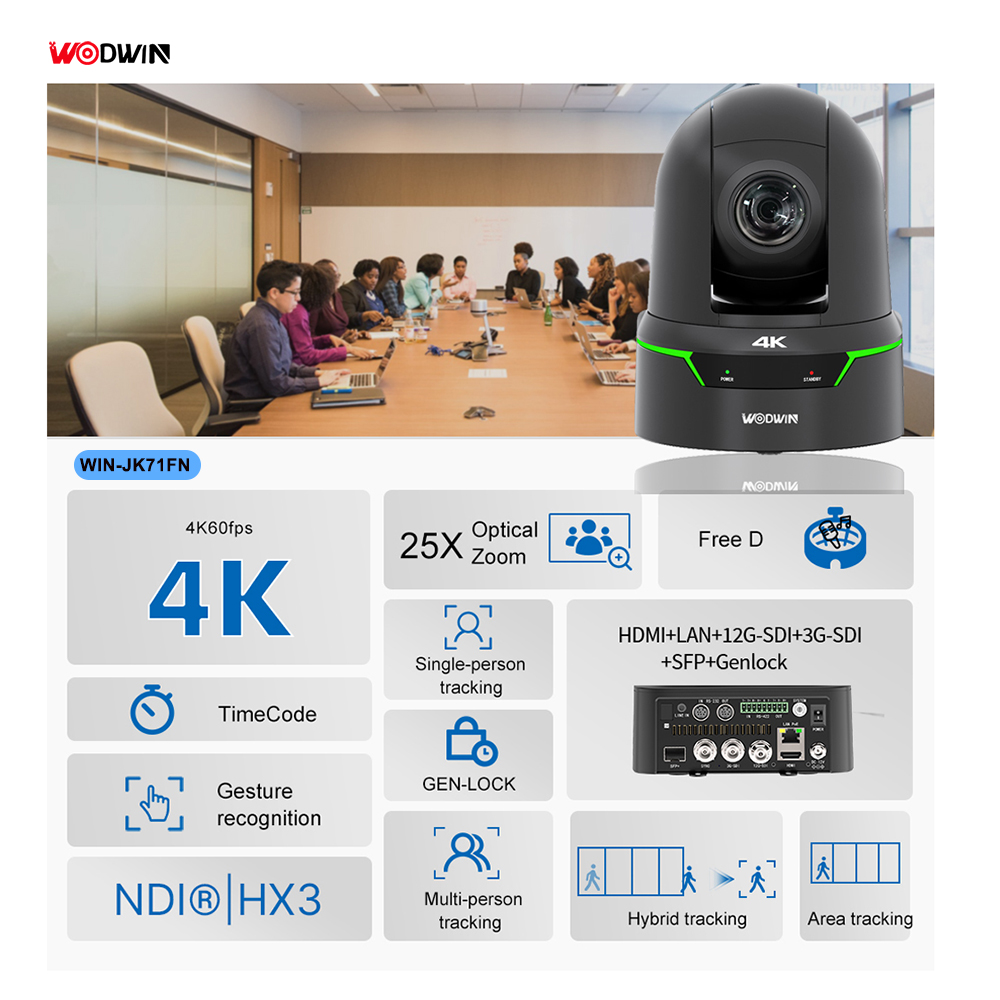
WODWIN WIN-JK71F latest 4K PTZ Camera
For decades, SDI has been the backbone of TV stations, professional studios, and large-scale live events. It operates independently of network systems, delivering stable, jitter-free signal transmission with zero packet loss.
What Is NDI?
NDI (Network Device Interface) is a modern IP-based video protocol developed for network-centric live production. It allows high-quality video, audio, metadata, and device control signals to transmit over standard Ethernet networks. Compatible with local LAN and cloud-based remote workflows, NDI turns any standard network cable into a multi-channel video routing solution.
With upgraded versions like NDI 6 and NDI HX, the protocol supports visually lossless compression, ultra-low latency, and automatic device discovery, making it wildly popular for hybrid studios, corporate events, church live streaming, and remote multi-site production.And WODWIN WIN-JK71S3N is NDI PTZ Camera with newest NDI|HX3 protol.
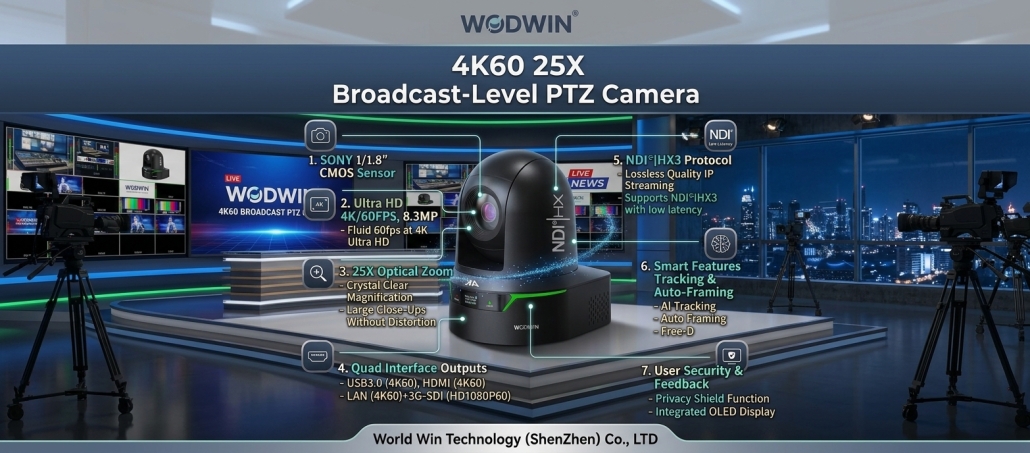
WIN-JK71S3N NDI PTZ Camera with newest NDI|HX3 protol.
2. Core Technical Comparison: SDI vs NDI
The biggest differences between SDI and NDI lie in transmission mode, latency, reliability, and infrastructure requirements. Below is a detailed professional comparison for live production scenarios.
Signal Quality & Compression
SDI: Delivers 100% uncompressed video. Every frame is transmitted in its original quality without compression or quality loss. 12G-SDI fully supports 4K 60fps 10-bit broadcast-grade video, meeting the strict quality standards of professional live broadcasting and post-production.
NDI: Standard NDI offers visually lossless transmission, while NDI HX uses efficient compression to reduce bandwidth consumption. For most live streaming, event production, and corporate video scenarios, NDI quality is indistinguishable from SDI. However, in ultra-high-standard broadcast scenarios, uncompressed SDI still maintains a slight edge in absolute image fidelity.
Latency Performance
SDI: Features near-zero, fixed deterministic latency. The hardwired coaxial transmission ensures no signal delay fluctuation, which is critical for live stage performances, real-time switching, and synchronous multi-camera production.
NDI: Full NDI achieves ultra-low latency (around 40–60ms), while NDI HX latency ranges from 80–200ms. This latency is acceptable for remote production, online streaming, and corporate events but may be noticeable for precise real-time stage monitoring and live switching in high-end broadcast scenarios.
Transmission Distance & Stability
SDI: Reliable for long-distance transmission. Standard coaxial cables support stable signal delivery up to 100 meters, and fiber SDI extensions can reach several kilometers. It is immune to network congestion, interference, and packet loss, delivering consistent performance in complex on-site environments.
NDI: Relies entirely on Ethernet network stability. Standard LAN transmission covers studio-scale distances, but signal quality drops sharply with unstable network bandwidth, wireless interference, or excessive device access. Poor network conditions cause frame drops, stuttering, and audio desync, which are fatal for live production.
Infrastructure & Deployment Flexibility
SDI: Requires dedicated coaxial cabling, SDI switches, converters, and professional broadcast hardware. Each video signal needs an independent cable route, resulting in complicated wiring, high on-site construction costs, and poor scalability. Adding new camera or signal sources requires re-wiring and hardware upgrades.
NDI: Uses existing standard Ethernet networks, eliminating messy dedicated video cables. Multiple video, audio, and control signals can be transmitted through one network cable. It supports automatic device discovery, flexible signal routing, and seamless expansion of multi-camera sources, greatly simplifying studio and event setup.
Cost Efficiency
SDI: High long-term deployment costs. Professional SDI cables, hardware switches, and converters are expensive, and wired renovation and maintenance consume massive manpower and time. It is only cost-effective for fixed high-end broadcast studios.
NDI: Low overall cost. It leverages universal network equipment with no need for dedicated broadcast hardware. It supports remote multi-site collaborative production, saving expensive on-site wiring and manpower costs, ideal for small-to-medium studios, mobile live events, and corporate AV systems.
3. Pros & Cons: SDI vs NDI
SDI: Pros & Cons
Advantages
-
Uncompressed, broadcast-grade video quality with zero quality loss
-
Fixed near-zero latency, perfect for real-time live switching and stage production
-
Extremely stable, anti-interference, no packet loss or frame drop issues
-
Mature and compatible with all professional broadcast cameras, switchers, and studio equipment
-
Long transmission distance suitable for large-scale fixed studios
Disadvantages
-
Bulky wired deployment with complicated wiring and high construction costs
-
Poor flexibility and scalability, difficult for temporary mobile events
-
Requires dedicated professional hardware, high equipment investment
-
Unable to support remote wireless and multi-site collaborative production
NDI: Pros & Cons
Advantages
-
High flexibility, supports wired/wireless network transmission and remote production
-
Simple deployment, reuse of existing network infrastructure, low cost
-
Multi-signal integration: video, audio, and device control via one network cable
-
Fast device discovery and flexible signal routing, easy to expand multi-camera sources
-
Perfect for mobile live events, corporate streaming, education, and hybrid studios
Disadvantages
-
Dependent on network stability, prone to frame drops and stuttering under poor bandwidth
-
Slight compression latency, not suitable for ultra-precise real-time broadcast scenarios
-
High network bandwidth requirements for multi-channel 4K NDI stream transmission
4. When to Use SDI vs NDI for Live Production?
Choose SDI If You Have These Scenarios
-
Professional TV stations, formal broadcast studios, and high-end live program production
-
Large-scale stage events requiring zero latency and synchronous real-time switching
-
Fixed long-term studio construction with high requirements for signal stability
-
Ultra HD 4K/8K broadcast production with strict image quality standards
Choose NDI If You Have These Scenarios
-
Mobile live events, temporary shooting scenes, and on-site live streaming
-
Corporate conferences, church live streaming, education recording, and webcast production
-
Small and medium-sized studios pursuing low cost and high flexibility
-
Remote multi-site collaborative production and cloud live streaming workflows
-
AV system integration projects requiring simple wiring and flexible expansion
5. The Future: Hybrid SDI + NDI Workflow
In 2026 and beyond, it is no longer necessary to completely choose between SDI and NDI. The most popular professional live production solution is a hybrid SDI + NDI workflow.
Many system integrators adopt a mixed setup: use SDI for core studio signal collection and real-time switching to ensure maximum stability and zero latency, while converting redundant signals to NDI via converters for network streaming, remote monitoring, and multi-terminal distribution. This solution combines SDI’s broadcast-grade stability and NDI’s flexible IP transmission advantages, perfectly adapting to modern diversified live production needs.In fact our Live streaming camera with with SDI and NDI interface both, do not worry how to choose, such as WIN-J86HKN 4K NDI Camera is 4K60FPS camera with 3G-SDI and NDI|HX3 low latency together.
6. Final Verdict
SDI remains the irreplaceable standard for high-end professional broadcasting and high-stakes live events that prioritize absolute stability, zero latency, and lossless quality.
NDI is the best choice for modern flexible live production, mobile events, corporate AV projects, and remote collaborative streaming, offering unmatched cost performance and scalability.
For most system integrators and production teams, building a hybrid SDI and NDI workflow is the most reasonable and future-proof solution to cover all live production scenarios.
FAQs About SDI vs NDI Live Production
Q1: Is NDI good enough for professional live streaming? A: Yes. NDI’s visually lossless quality and ultra-low latency fully meet the standards of most professional live streaming, corporate events, and studio production. Only top-tier broadcast scenarios still require pure SDI workflows.
Q2: Does NDI lag worse than SDI? A: Standard NDI latency is barely perceptible for most audiences and operators. Only in high-precision real-time switching and stage monitoring scenarios can the tiny latency gap between NDI and SDI be distinguished.
Q3: Can SDI and NDI work together? A: Absolutely. With SDI-to-NDI converters, you can seamlessly integrate the two protocols to build a stable, flexible, and cost-effective hybrid live production system.
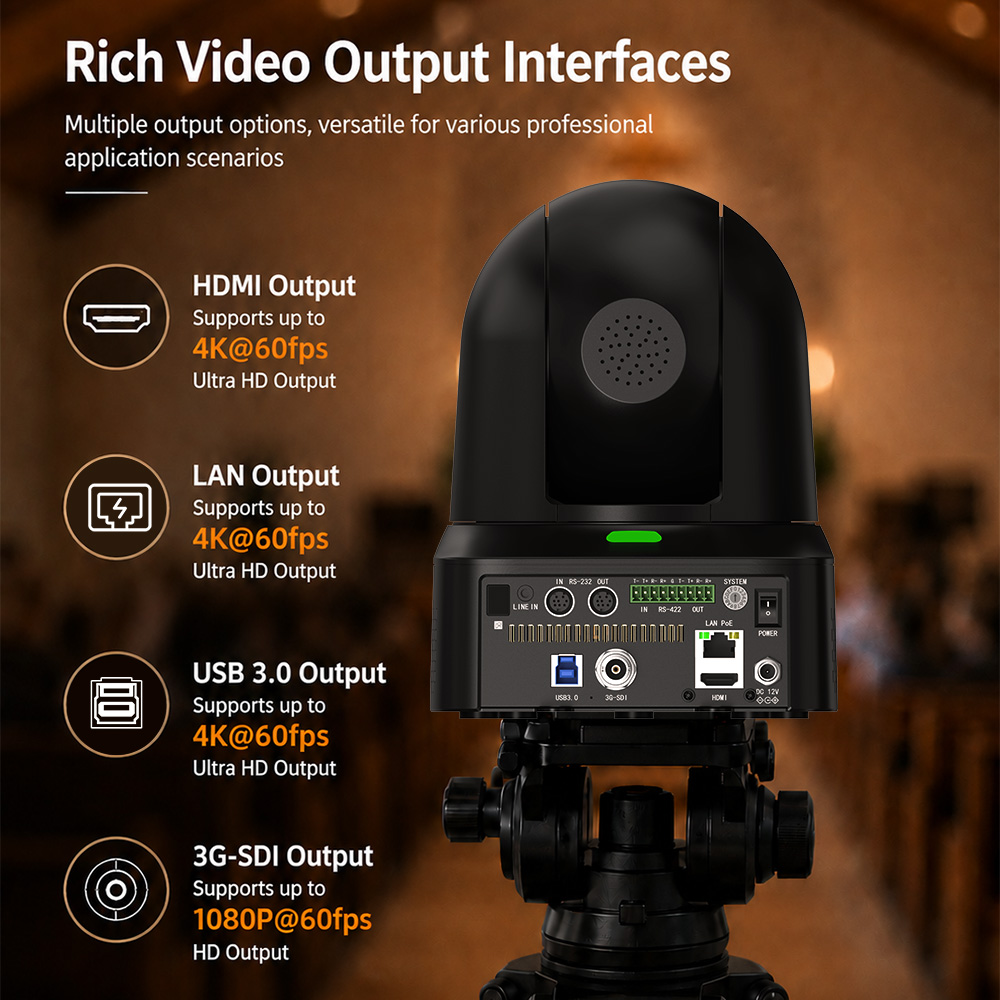
WIN-JK71S3N SDI NDI PORT
Which Camera is the best one with both SDI and NDI ? If you have enough budget, we sugguese use WIN-JK71S3N which is 2026 new 4K60FPS camera with NDI and SDI interface. For more details, welcome to contact with WODWIN, who can supply you professional Broadcasting grade Cameras, Live Streaming PTZ SDI Cameras, 4K PTZ Cameras, NDI PTZ Cameras, Joystick Controllers, Video Swithers, etc.Send us inquiry for price: sales@wodwins.com
